%202.png)
WCP Women Who travel— Pt 4: Building With, Not For — What Social Impact Consulting Taught Me From Delhi to the UN
- Sam Park
- Apr 27
- 7 min read
Delhi taught me how change feels. New York taught me how change is built. But it was the people in between, women in a Delhi slum and farmers in a Tanzania policy brief, who taught me what change is actually for.
Before these experiences, social impact consulting was a phrase I admired more than I fully understood. I associated it with strategy, policy, and development, all things that sounded meaningful, but still somewhat distant. It was only after moving between two very different experiences, a microfinance project with ASHA in Delhi and a policy proposal connected to the United Nations in New York, that I began to understand what impact really demands.
At first glance, the two seemed worlds apart, one grounded in lived realities and face-to-face interactions, the other in institutions and global policy. But both taught me the same lesson: real impact happens when empathy is translated into structure, and when structure remains accountable to people.
My first experience came through the IBUS India programme in January 2025 (Please read our other WCP article about IBUS Vietnam here). The program was structured in two parts. The first week focused on cultural and academic immersion, while the second week was centred on project work. Looking back, that structure mattered more than I expected. It allowed the experience to begin not with a task, but with a deeper understanding of its culture and history.
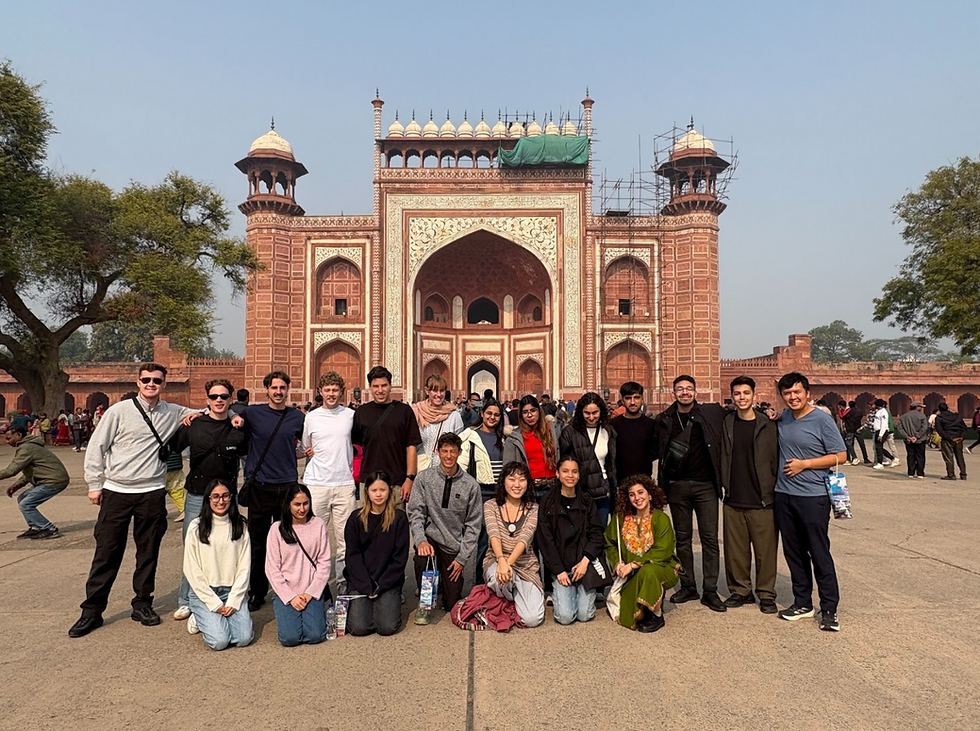
Image 1 - 2025 IBUS Delhi Cohort

Image 2 - In front of the Taj Mahal
During that first week, we explored Old Delhi, drank masala chai in the middle of the street, got henna on our hands, and rode tuk-tuks through the city. I did outdoor yoga, visited IIT Delhi, and travelled to Agra to see the Taj Mahal and Agra Fort. Seeing the Taj Mahal in real life had long been one of my dreams, and learning about its historical and cultural significance made me feel deeply connected to India in a way I had not expected. As someone who has lived in Korea and studied in Australia, I also found it fascinating to see how differently business and policy operate in a developing country context.
Then came the second week, when we began our consulting project with ASHA, an NGO working to break cycles of poverty in the slums of Delhi through education, healthcare, financial inclusion, and women's empowerment.

Image 3 - My teammates and I in front of ASHA

Image 4 - Presenting our Reward Programme proposal
Our project focused on microfinance education strategies in slum communities. We looked at the barriers preventing stronger financial inclusion and asked why education-based approaches might create more sustainable impact than direct cash donations alone. That question mattered to me. Direct aid can be important, but when it is poorly designed, it can sometimes relieve immediate pressure without building long-term capacity. Our team developed several recommendations, including a rewarding program, financial literacy initiatives, and longer-term ideas such as pension-related support.
My own focus was on the rewarding program. I worked on a proposal where community members would receive vouchers after completing a certain amount of microfinance education, with those vouchers designed to be used only in local shops and markets within the slum area. I loved this idea because it tried to do two things at once: improve financial literacy while also circulating value back into the local economy. It was a small but intentional example of designing for both individual support and community sustainability.

Image 5 - Women I met in Delhi (1)
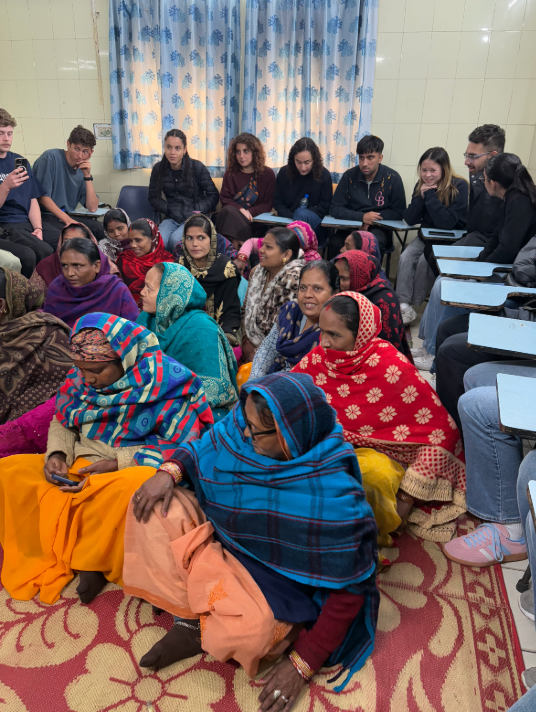
Image 6 - Women I met in Delhi (2)
But what stayed with me most from Delhi was not only the framework we presented. It was the women I met. I remember being genuinely mesmerised by the women representatives in the community. They were energetic, confident, and deeply committed to improving the places they lived in. Even though they did not speak English, they were eager to communicate their concerns, their ideas, and their hopes for change. They were warm, smiley, and full of conviction. Before this experience, I think part of me had unconsciously assumed that external actors, such as consultants, international organisations, or development agencies, would have to come in and lead solutions because local communities lacked resources, knowledge, or direction.
I was wrong.
The women in the community understood their realities far better than any outsider could. More importantly, they had something no consultant could ever build overnight: trust, relationships, and lived understanding. They were not passive recipients of help. They were already leaders.
That changed the way I thought about impact. Even the most polished recommendation can fail if it is imposed without genuine collaboration. A strategy becomes meaningful only when it works with the way people actually live, communicate, and make decisions. Social impact work should never be about forcing change onto people. It should be about building with them.
That experience also sharpened a question I kept returning to: if microfinance can open doors, what determines whether people actually walk through them? No single solution works for everyone. People's needs are shaped by context, by instability, by factors that no financial tool can fix alone. That question did not leave me. It followed me, a few months later, all the way to New York.

Image 7 - In front of the UN Headquarters logo
From May to August 2025, I participated in the WFUNA College Leaders at the UN (CLUN) programme, a global youth leadership initiative where university students research and develop policy proposals aimed at advancing the SDGs across economic, social, and environmental dimensions, presented directly to UN specialists. After months of research and preparation, I travelled to New York in August for a week of final presentations and sessions, and the city became part of the experience in ways I had not entirely expected.

Image 8 - View from Top of the Rock

Image 9 - UN Garden Tour
Outside the research and presentations, the city itself became part of the experience. I did yoga in Central Park, watched The Great Gatsby on Broadway, and looked out over the city from Top of the Rock. Those moments gave the week a texture beyond policy discussions and presentation rooms, and reminded me that growth does not only happen in formal spaces.
Throughout the week, we attended sessions from UN practitioners sharing their real-world experiences, deepened our understanding of the UN's history and how it operates, and pushed hard on our proposal ahead of the final presentation.

Image 10 - WFUNA CLUN 16 Team A, Economic Policy division

Image 11 - Final policy presentation
Our team focused on Tanzania, asking a question that felt increasingly important in a rapidly changing world: as economies become more shaped by AI and digital transformation, what happens to countries whose livelihoods still depend heavily on agriculture and natural resources? Do they simply have to wait to move through a traditional path of industrial development, or can emerging technologies strengthen the sectors they already rely on?
Our proposal, Value Creation Through Digitisation: Tanzania’s Agricultural Chain, began with the belief that they could. But as we researched the sector more deeply, it became clear that the central challenge was not just low productivity. It was fragmentation. Smallholder farmers were often disconnected from reliable buyers, had little visibility over pricing and produce movement, faced significant post harvest losses, and lacked access to systems that could strengthen their bargaining power and long term stability. In other words, the problem was not simply that farmers produced too little, but that the value chain around them was inefficient, opaque, and unevenly structured.
That became the focus of our policy proposal. We explored how AI and digital tools could be used not to replace agriculture, but to make the agricultural system work better for the people already sustaining it. More specifically, we proposed a model centred on a digital platform and supporting logistics infrastructure that could connect farmers more directly with buyers, improve traceability across the supply chain, reduce losses in storage and transport, and create more transparent channels for pricing, distribution, and payment. The goal was to reduce supply chain fragmentation, improve the livelihoods of smallholder farmers, and ultimately support a more inclusive and resilient form of economic growth in Tanzania.
The biggest challenge, however, was feasibility. It was one thing to imagine a digitally integrated system on paper, and another to ask whether it could function in rural contexts shaped by unstable internet access, inconsistent electricity, and uneven digital literacy. Early on, some of our ideas leaned further into advanced AI, but the more we debated implementation, the more we realised that innovation only matters when it is usable. In many parts of the chain, simpler systems such as QR codes, barcodes, and accessible traceability tools seemed more realistic and more effective than forcing advanced AI into every stage of the process. Those conflicts did not weaken our proposal. They made it better, forcing us to think not just about innovation, but about implementation. New York taught me that policy work is not only about visionary ideas. It is about building ideas that can survive contact with reality.
Yet despite how different the two projects felt, I kept returning to the same principle: understand the people first. That is what social impact consulting has come to mean to me. Not speaking for communities, not arriving with a polished deck and assuming strategy alone is enough. It is about listening carefully, understanding stakeholders deeply, and designing systems that allow people to grow, produce, negotiate, and protect themselves more fairly. Because there is a difference between building for people and building with them, and everything I learned, from Delhi to the UN, lives in that gap.
Looking back, what connected Delhi and New York most was not the subject matter or the scale. It was the moments of genuine human exchange. Whether it was sitting with women in a Delhi slum who shared what they needed with someone they had never met, or hearing directly from UN practitioners who had spent years working in the field, those moments reminded me that the people behind every policy brief, every recommendation, every framework, are real. If Delhi taught me the human why behind impact, New York taught me the structural how. Real change begins with people, but it lasts through systems. And the most meaningful work is not about helping from a distance. It is about building with people, so that impact is not only immediate, but fair, sustainable, and truly their own.


Comments